
The Connections and Progression of Good Comedy.
Something fascinates me about the humor of Far Side--arguably the best cartoon strip of all time.
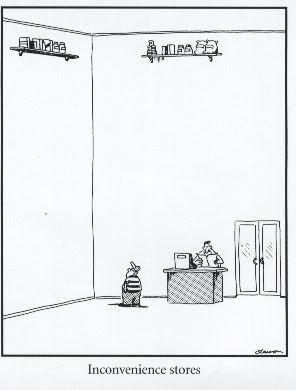
Do you ever notice that the caption (text) is completely reliant upon the cartoon (image), and vise versa? That is, the joke will not be understood unless the audience makes the connection (the "discovery") between what they see and what they read.
Audiences love making discoveries. The gasp, the ah-ah!, the satori moment is what convinces the crowd that the humor is brilliant--because they believe they are being brilliant.
There are far too many examples of the alternative, where everything is spelled out for the idiot Sunday comic reader. For example, Family Circus:
 How is this remotely clever?
("TEE-HEE! CHILDREN DON'T WRITE BLOGS! THAT'S ABSURD!")
How about Marmaduke? Now there's a clever comic!

How about Marmaduke? Now there's a clever comic!
("HAR! HAR! HAR! DOG'S DON'T HUG! THAT'S SO FUNNY!")
This is a rare exception--a Marmaduke that's actually clever:

Now we talk about progression of humor, often using the "rule of threes." (Usually follows a pattern: funny, funnier, funnest. Or normal, normal, absurd. Mix-and-match.) I consider Dilbert a perfect comic that exemplifies this progression. I call Dilbert "smart humor" because there's always a clever progression, not just a clever observation or outrages situation. Notice how the first frame is always a 'funny' or 'absurd' setup. The second frame bounces off of the first frame's idea, and finally climaxes on the third.

Humor. There's a lot to it, and no, I don't know everything about it. Most of my experience is derived from trial and error (emphasize the error).
Basically, don't think just a clever statement is going to be funny when it's unsupported by context (i.e. it's "random"), or it's devoid of life-relevance (i.e. it's "pointless").
> Sarcasm is awesome, but what are the effects of excessive sarcasm? Is it different from dry humor?
> How to be "funny." Don't push it. (i.e. don't say to yourself, "I've got to make these people laugh.")
> Slapstick humor: Laughing at other's misfortune? Or laughing at absurdity?
> If it's not true, it's not funny.
This is a rare exception--a Marmaduke that's actually clever:
Humor. There's a lot to it, and no, I don't know everything about it. Most of my experience is derived from trial and error (emphasize the error).
Basically, don't think just a clever statement is going to be funny when it's unsupported by context (i.e. it's "random"), or it's devoid of life-relevance (i.e. it's "pointless").
More notes coming soon regarding:
> Acknowledging excitement or funniness is the quickest way to snuff it out.> Sarcasm is awesome, but what are the effects of excessive sarcasm? Is it different from dry humor?
> How to be "funny." Don't push it. (i.e. don't say to yourself, "I've got to make these people laugh.")
> Slapstick humor: Laughing at other's misfortune? Or laughing at absurdity?
> If it's not true, it's not funny.


1 comment:
Hi Beau! Be honered because I have never before left a comment for anyone on a blog...ever. fun stuff. I agree on your critism of Mamaduke. I prefer Get Fuzzy when it comes to animal comics. And Dilbert is a riot, but for some reason he rarely makes me lol as the animals do. Curious. I think it has to do with the images in Dilbert being a bit drab. I think expression is important as well as witty dialogue, but then...I am a Chevassus.
Post a Comment